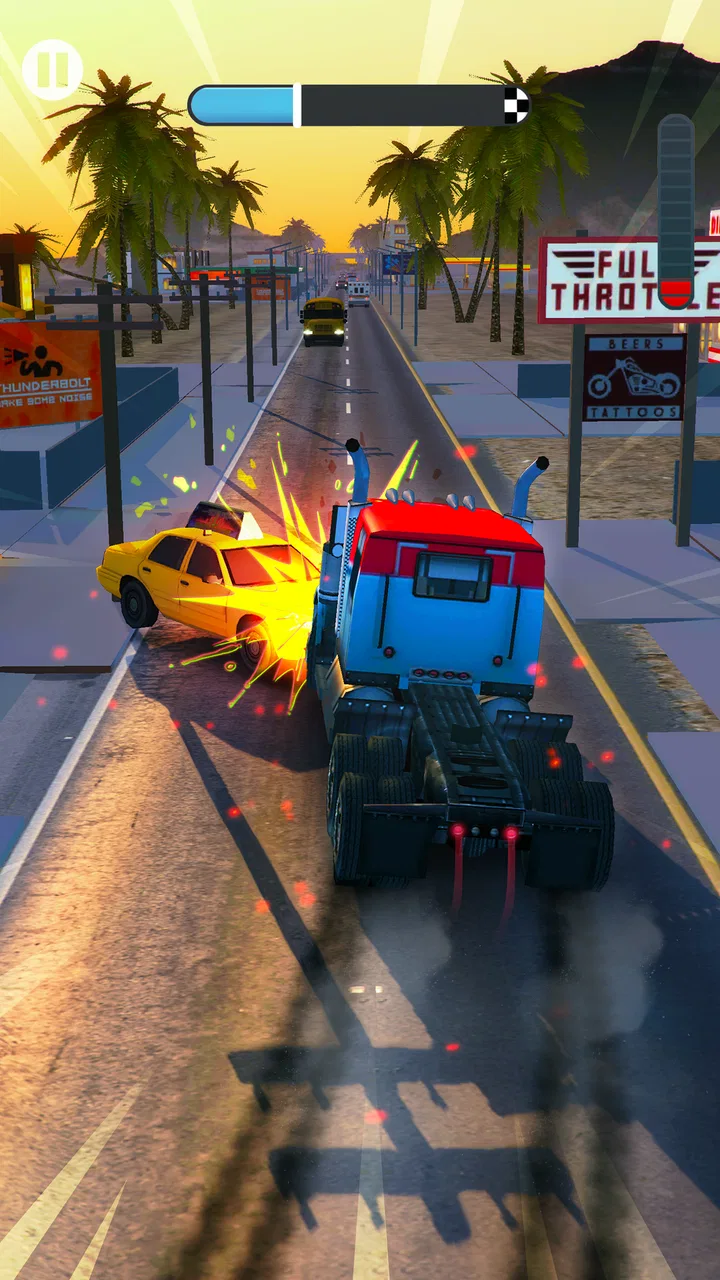
Overtake Rush 3D: Car Game
- 4.5
- Rating
- 10.00M
- Installs
- Free
- Price

 Analysis by App-foxy
I usually know within the first few sessions whether a racing game has more to offer than a flashy opening. Overtake Rush 3D: Car Game made a good first impression because it gets straight to the part many mobile players want: weaving through traffic, pushing for a clean overtake, and reacting quickly when police pressure turns an ordinary drive into a chase. It is a free racing game from CASUAL AZUR GAMES, aimed at players aged Everyone 10+, and its simple premise makes it easy to pick up without a long tutorial or a complicated career structure getting in the way.
That accessibility is also the central question here. A quick traffic run can be perfect when I have a few spare minutes, but a game built around repeated overtakes needs enough variety and control to stay interesting after the novelty wears off. I spent time looking at it from that angle rather than judging only the first burst of excitement. My conclusion is fairly clear: it is a convenient arcade racer for short sessions, especially if you enjoy tense lane changes and police-chase energy, but it is not the best fit for someone looking for deep vehicle tuning, a substantial racing simulation, or a long-form driving campaign.
What the first week feels like
The opening appeal comes from how quickly the game communicates its purpose. You are not being asked to study a detailed circuit or learn a large collection of racing rules. The focus is traffic, speed, and the decision of when to move into a gap. That creates a useful rhythm: scan the road, choose a lane, overtake, and prepare for the next obstacle. When a police chase becomes part of the run, the same basic action feels more urgent because a mistake is no longer just a lost position.
You May Also Like

 Blood Strike: 2.5 Anniversary
Blood Strike’s Loadouts Turn Every Drop Into a Tactical Gamble
A close look at Blood Strike’s custom loadouts: how fast access to signature weapons reshapes its battle royale rhythm, rewards preparation, and narrows the gap between fights.

 Pandora - Music & Podcasts
Pandora’s Music Is Easy to Start, but Harder to Recover
Pandora’s strength is its low-effort path from a seed to a station. Its weak spot is how much confidence it asks you to place in connection, setup, and quiet recovery.

 8 Ball Pool
 Is Built on Rivalries, Rematches, and Routine
A close look at the rivalries, rematches, shared routines, and unanswered safety questions that turn a quick pool match into a persistent mobile community.

 Samsung Music
’s Quiet Strength Is Playing What You Already Own
Its reach comes less from spectacle than from dependable access to a personal library. That simplicity is both the app’s strongest retention engine and its ceiling.

 AccuWeather: Weather Radar
AccuWeather Review: A Quick, Clear Forecast for Everyday Decisions
For everyday plans, the best forecast is the one you can understand quickly. AccuWeather makes rain timing, radar, and local conditions easy to act on, with a few trade-offs.

 Hill Climb Racing
Why Hill Climb Racing Still Turns Crashes Into One More Run
A tiny car, a bumpy hill and one more upgrade: Hill Climb Racing keeps resurfacing because its simple chaos makes every near-miss feel personal.
More From Our News Desk



I like this kind of design for a phone because it respects the way mobile games are often played. A player may open the game while waiting for transport, during a short break, or when there is only enough time for a handful of attempts. The straightforward format means I can return without needing to remember a complicated objective. It is also friendly to people who do not normally play racing games, since the immediate challenge is easy to understand even if improving at it takes practice.
The traffic itself gives the game a more active feel than a conventional race against a fixed group of opponents. Instead of concentrating only on an ideal racing line, I have to judge moving spaces and react to changing road conditions. That small shift matters. It makes a successful overtake feel like a personal decision rather than simply following the fastest route around a track. The best moments are not necessarily the fastest ones; they are the close passes where I commit at the right instant and keep control.
The police-chase element adds another layer to the first-week experience. It gives the driving a sense of consequence and helps separate the game from a basic traffic-dodging exercise. I found that it encouraged shorter, more focused sessions because the pressure rises quickly. If you enjoy games that turn a familiar action into a risk calculation, this is likely to be the part that keeps you returning during the early days.
Still, the first-week excitement depends heavily on whether you enjoy repetition. The core loop remains centered on driving through traffic and avoiding trouble. Players who prefer constant new tracks, detailed objectives, or a wide range of race formats may feel that the initial surprise fades sooner. This is not a criticism of the basic idea; it is a reminder that the game’s appeal is concentrated rather than broad.
One useful way to approach the first sessions is to treat each run as practice in timing rather than as a simple attempt to go as fast as possible. I got better results when I watched the space beyond the nearest vehicle and planned the next move before completing the current overtake. That habit reduces last-second swerves and makes the chase sections feel less random. It is a small technique, but it gives the game a little more depth than the short store summary suggests.
The game’s audience size suggests that this accessible formula has found a substantial mobile audience. It has passed over ten million installs and carries a 4.5 average from around 233 thousand ratings, with roughly 2.9 thousand written reviews. Those figures do not guarantee that every player will enjoy the same style, but they do indicate that the quick, traffic-focused format is not an obscure experiment. I would still judge it by the type of racing you want rather than by popularity alone.
Who gets the most from the early sessions
This is a strong starting point for someone who wants immediate driving action without learning a simulation model. It suits casual players, younger players within the age guidance, and anyone who enjoys chasing a better run through repeated attempts. It also works for people who like the feeling of escaping danger more than the formal structure of a traditional race.
It is less convincing for a player who expects realistic motorsport. The game’s emphasis is on extreme driving and police pursuit, not on recreating the careful pace, technical setup, and race strategy of a console or PC simulator. If your favorite part of racing is adjusting suspension, managing tire wear, or studying a circuit, this will probably feel too light. A more detailed racing game would be a better choice for that audience, even if it takes longer to learn and demands longer sessions.
Does it keep earning space after the novelty?
After the first week, the important question changes from “Is this exciting?” to “Why would I open it again tomorrow?” For me, the answer is the compact challenge. A traffic run can fill a small break without requiring a large commitment, and the chase setup creates enough pressure to make another attempt tempting. That is genuine recurring value, but it is a narrow kind of value. The game works best as a repeatable snack rather than as the one racing title I would build my entire mobile library around.
The strongest long-term habit is improvement through judgment. I can focus on safer lane choices, cleaner overtakes, and better reactions instead of simply hoping for a lucky run. To make that habit stick, I recommend setting a small personal target for each session. One time I might concentrate on avoiding unnecessary risks; another time I might try to maintain momentum through denser traffic. This approach prevents every session from becoming an identical race for speed.
That distinction is important because the game does not need a huge amount of content to be useful, but it does need the player to create some of the variety. If I open it without a purpose, the repeated driving can begin to blur together. If I decide to practice a specific skill, the same road becomes a training ground. In other words, its lasting value comes partly from how actively I engage with the driving rather than from a deep progression system that constantly supplies new reasons to play.
A realistic everyday use case would be a ten-minute break between tasks. I can start a run, make a few attempts, and stop without feeling that I have abandoned a long race or wasted a carefully prepared setup. That makes it more practical than many traditional racing games on mobile, which may ask for longer uninterrupted attention. The trade-off is that the short-session design may feel thin on a quiet evening when I want a richer sense of progression.
The free entry point helps with that decision. I can try the game without paying first, then decide whether it deserves regular space on my device. Optional purchases range from $0.99 to $5.99 per item, so I would treat them as a convenience or support choice rather than something to consider before understanding the basic loop. My advice is to play long enough to see whether repeated traffic runs remain enjoyable on their own. If the core action already feels repetitive, spending money is unlikely to solve that problem.
The current version is 1.1.12, and the game supports Android from version 7.0 onward. That makes it accessible to many older Android devices, although compatibility alone does not tell me how smoothly every phone will handle a fast driving scene. On a practical level, I would check that the game feels responsive on the device I plan to use before committing to it as a daily time filler. In a game built around narrow gaps, even a small feeling of sluggish control can become frustrating.
What helps the habit, and what weakens it
The game earns repeat visits when I want a quick test of attention. It is especially effective after a stressful task because the objective is simple: read the road and stay alive in the flow of traffic. That simplicity can be calming when I approach it casually, but it can also become irritating if I chase perfect runs without accepting that risky overtakes will sometimes fail.
One of the more useful habits is separating “safe progress” from “showy progress.” A close pass may feel satisfying, but taking every available gap is not always the smart route. I found that preserving control usually mattered more than forcing an impressive move. This is the kind of trade-off that gives the game a modest strategic layer: the fastest-looking decision is not automatically the best one when the chase pressure is rising.
Another tip is to avoid judging the game only by how much content it presents at once. Its value is better measured by whether the driving itself remains readable and satisfying. If you enjoy refining reactions, it can remain a handy short-session game. If you need a constant stream of unlocks, locations, and new race rules, the habit will probably weaken once the opening excitement has passed.
Maintenance, friction, and the reasons fatigue appears
There is not much maintenance in the traditional sense. I do not need to manage a large garage, prepare a complicated setup, or remember a long chain of objectives before playing. That low overhead is one of the game’s practical strengths. It is easy to return after several days away because the basic task remains obvious.
However, low maintenance does not mean zero friction. Repeated traffic runs can place a lot of responsibility on moment-to-moment control. When a run ends after a rushed decision, I may understand what went wrong, but that does not always make the next attempt feel meaningfully different. The game asks me to improve within the same central activity, so my tolerance for repetition becomes the deciding factor.
The police-chase pressure can also work in both directions. It adds urgency when I want a more dramatic drive, but it can make a relaxed session harder to find. Players who prefer calm cruising may see the chase as an interruption rather than an enhancement. Conversely, players who want constant danger may appreciate that the game does not let traffic driving become completely passive.
Another source of fatigue is the gap between arcade excitement and realistic racing expectations. The title presents itself as a racing experience, but the appeal is closer to an action-focused traffic challenge than to a full simulation. That is not a flaw when the player understands the bargain. It becomes a problem only when someone downloads it expecting detailed car behavior, authentic race management, or a substantial competitive structure.
There is also a psychological maintenance cost: deciding when to stop. Because a run is short and the next attempt is always easy to begin, it is tempting to keep replaying after a disappointing result. I recommend setting a session limit or stopping after a personal best. Without that boundary, the game can turn from a useful break into a repetitive loop, particularly when the goal becomes correcting one mistake rather than enjoying the driving.
The in-app purchase range is another point to consider before making it a regular game. A free download is welcome, but optional items can change how comfortable a player feels about continuing. I would not make a purchase simply because a run went badly or because I wanted to accelerate a short-term goal. First decide whether the unmodified experience provides enough entertainment. For a casual traffic racer, that test is more important than the size of any individual item.
Players also often wonder whether this can replace a more complete racing game. In my view, it cannot, and it does not need to. It fills a different role. A traditional racer is better when I want structured events, longer concentration, and a sense of building a driving career. This game is better when I want immediate movement, quick decisions, and the tension of getting through traffic. Keeping that distinction clear prevents disappointment.
When another racing game is the better choice
I would skip this one if my main reason for downloading a racing game were customization, realism, or a broad range of competitive modes. I would also look elsewhere if I disliked repeating similar runs or if police pursuits made driving feel unnecessarily hectic. A track-based racer would offer clearer lap-to-lap comparison, while a simulation-focused title would provide more mechanical detail.
On the other hand, I would choose it over those alternatives when I need a game that starts quickly and does not demand a long appointment. It is a sensible companion for short breaks, casual play, and players who enjoy the small satisfaction of finding a gap in traffic at exactly the right time. The best audience is not looking for a complete driving hobby; it is looking for a focused burst of road action.
My long-term verdict
Overtake Rush 3D: Car Game earns a place on my device when I want a compact arcade racer with traffic weaving and police-chase tension. Its first-week appeal is immediate, its controls and objectives are easy to understand, and its free starting point makes trying it a low-risk decision. The developer, CASUAL AZUR GAMES, has chosen a focused concept rather than an overloaded racing package, and that focus is exactly why the game can work well in short sessions.
Its lasting value is more conditional. The game can become a useful daily habit if I enjoy practicing timing, reading traffic, and improving one run at a time. It is less likely to last if I need frequent new systems, deep vehicle management, or a strong sense of campaign progression. The same simplicity that makes it approachable also limits how much it can surprise me later.
My practical recommendation is to treat it as a specialized mobile racer. Download it if you want quick, tense driving and are happy to create your own small goals. Give it a fair trial before considering the optional purchases, and use short session limits if repeated attempts begin to feel automatic. Skip it in favor of a more detailed racing alternative if realism, customization, or structured championships matter more than instant action.
My final take: it earns lasting space as a quick traffic-and-chase game, not as a complete racing replacement. That is a modest role, but it is a useful one. When I want a fast break filled with risky overtakes and immediate decisions, it delivers. When I want a deeper driving experience that keeps unfolding over weeks, I would reach for something more substantial.
FAQs for Overtake Rush 3D: Car Game
01What is Overtake Rush 3D: Car Game?
Overtake Rush 3D: Car Game is a casual arcade driving game focused on weaving through traffic, overtaking vehicles, and reaching the finish line without crashing. Its gameplay is designed to be easy to understand, with simple controls and short challenges that suit quick play sessions. The 3D presentation, moving traffic, and increasing speed give each level a fast-paced feel, although the experience is more arcade-oriented than a realistic racing simulator.
02How do you play Overtake Rush 3D: Car Game?
The main objective is to guide your car through busy roads while passing traffic and avoiding collisions. Depending on the control setup available on your device, you generally swipe or tap to move between lanes and adjust your position. Timing is important because vehicles can change your available path quickly. Successful overtakes help you progress, while hitting other cars may end the run or reduce your chances of completing the challenge.
03Is Overtake Rush 3D: Car Game free to download and play?
Overtake Rush 3D: Car Game is generally offered as a free download, allowing players to try the core driving gameplay without paying upfront. However, free mobile games may include advertisements, optional purchases, or other monetization features. Availability and pricing can vary between the Android and iOS versions, so it is worth checking the store listing before downloading. Parents may also want to review purchase settings if children use the device.
04Can Overtake Rush 3D: Car Game be played offline?
The basic driving challenges may work without a constant internet connection, which makes the game convenient for short sessions while traveling or when mobile data is unavailable. Nevertheless, certain features can require internet access, including advertisements, store content, updates, rankings, or analytics. Offline behavior may also differ between versions and devices. For the most reliable information, players should check the current Google Play or App Store description and test the game after installation.
05Is Overtake Rush 3D: Car Game suitable for children and casual players?
The game is generally suitable for casual players because its premise is straightforward and the controls can be learned quickly. It does not focus on realistic driving rules, so younger users can understand the objective without extensive tutorials. That said, difficulty may increase as traffic becomes denser and reactions need to be faster. Adults should still check the age rating, advertising content, and in-app purchase options before allowing children to play independently.
Pros
- Simple controls make it easy for beginners to start playing.
- Short races are ideal for quick gaming sessions.
- Bright 3D visuals give the tracks a lively appearance.
- Overtaking traffic creates an engaging risk-and-reward challenge.
- The game can be enjoyable for casual players without racing experience.
Cons
- Gameplay may feel repetitive after playing several similar races.
- Frequent obstacles can make some crashes feel frustrating.
- Progression may seem limited for players seeking deeper career modes.
- The small cars and tracks can reduce the sense of realistic racing.
- Ads may interrupt the experience
- depending on the version and device.

Overtake Rush 3D: Car Game
Gallery